
A structured comparison for Indian students and families navigating one of the most consequential decisions of their academic journey – without the noise.
Every year, thousands of students from Hyderabad and across South India walk into an overseas education consultation with a single question: Which country should I choose? The answer is rarely a headline. It is a function of your academic profile, financial capacity, career trajectory, and long-term residency intent – weighed against each destination’s evolving policy landscape.
In 2026, the global study-abroad environment has shifted in meaningful ways. Visa scrutiny has tightened in some corridors; graduate employment pathways have widened in others. As abroad education consultants working closely with students across Telangana and Andhra Pradesh, we at EdWest Global have observed these shifts firsthand. This guide is built on that ground-level experience – not on promotional positioning.
Understanding What “Best” Actually Means
There is no universally superior destination. What exists is a spectrum of trade-offs. A student targeting a two-year master’s in Computer Science with strong post-study work intent should evaluate these three countries very differently from a student seeking a research-led PhD or a business undergraduate looking for a globally networked alumni base.
The framework below examines five core dimensions that matter most to Indian students: tuition and living costs, academic quality and program diversity, post-study work rights, permanent residency pathways, and the practical experience of being an international student on the ground.
“The question is never which country ranks highest globally. The question is which country is best aligned with your specific goals – today and five years from now.”
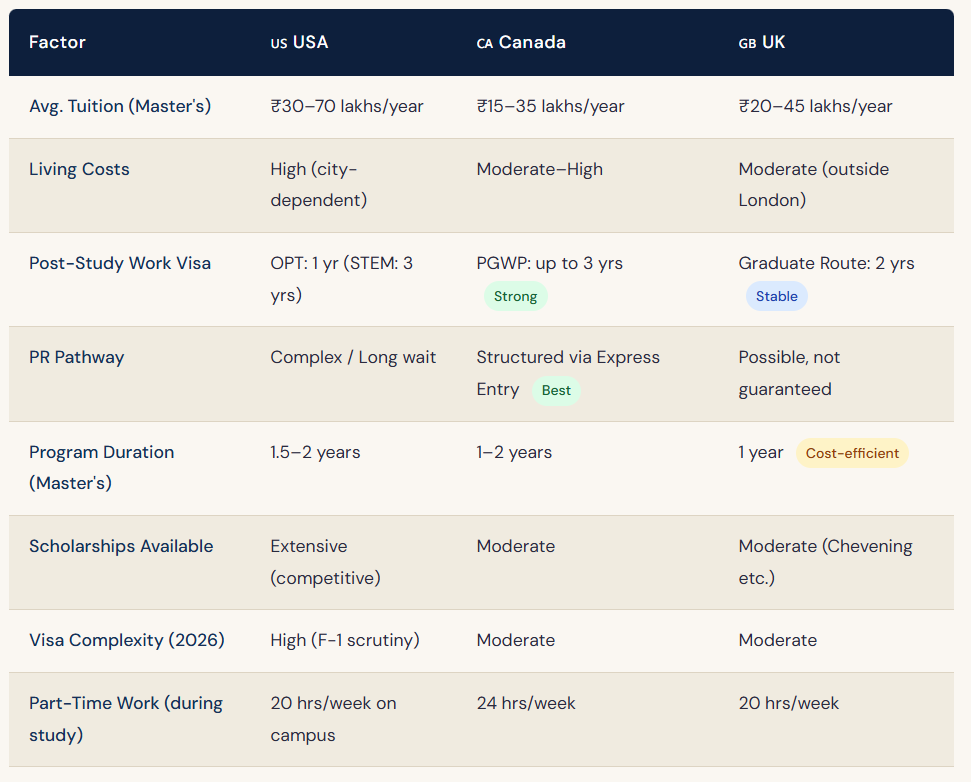
At a Glance: USA vs Canada vs UK in 2026
The United States: Prestige With Complexity
American universities continue to dominate global rankings, and for students targeting roles in technology, finance, or research at a global level, the US ecosystem remains unmatched. The concentration of Fortune 500 headquarters, elite research labs, and venture-backed startups creates an environment that few other countries can replicate.
That said, 2026 brings renewed scrutiny for international students. F-1 visa processing times have increased, and OPT extensions – while still available for STEM graduates – require consistent compliance and employer sponsorship navigation. The H-1B lottery remains a significant structural barrier for long-term residency aspirations.
From a cost standpoint, the US is the most expensive of the three. Students from Hyderabad should realistically plan for a total investment of ₹80 lakhs to ₹1.5 crore for a two-year master’s program, depending on institution and city. That said, merit scholarships and teaching/research assistantships can substantially offset this – but competition is intense.
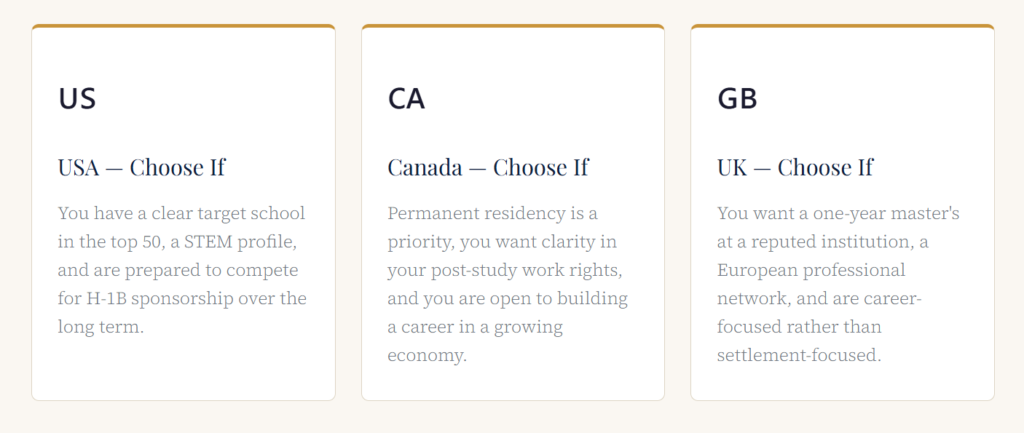
Best suited for: Students with strong academic records targeting top-20 universities, STEM profiles with clear employment plans, and those with long-term US career ambitions willing to navigate the immigration system.
Canada: The Structured Pathway
Canada has, over the past five years, established itself as the most predictable destination for Indian students who want a clear route from study to work to permanent residency. The Post-Graduate Work Permit (PGWP) system allows graduates to remain and work for up to three years, and Canada’s Express Entry system explicitly awards points for Canadian work experience and education.
For students from South India – particularly those consulting with overseas education consultants in Hyderabad – Canada consistently emerges as the preferred choice when long-term settlement is a priority. Cities like Toronto, Vancouver, and Calgary have established Indian communities, and the cultural transition tends to be smoother relative to smaller UK university towns or certain US cities.
One important caveat in 2026: Canada has reduced its international student caps at the federal level, and some provinces have tightened Post-Graduation Work Permit eligibility based on institution type. Not all colleges qualify. This is where guidance from experienced best study abroad consultants becomes practically important – the institution selection decision directly affects your work authorization after graduation.
Best suited for: Students targeting permanent residency, healthcare, business management, or applied technology programs; those who value a structured immigration system over a top-tier research environment.
The United Kingdom: Efficiency and Depth
The UK’s graduate route visa – introduced in 2021 and stable through 2026 – allows two years of post-study work (three for PhD graduates). Combined with the fact that most UK master’s programs are completed in one year, the cost-to-duration ratio is significantly more favourable than the US or Canada for students who are certain about their field.
British universities carry centuries of institutional depth. For students pursuing law, humanities, finance (particularly in London), architecture, or the arts, the UK offers a quality of exposure that is difficult to replicate. Russell Group universities are globally respected, and proximity to Europe adds a dimension of cultural and professional exposure that is unique to UK study.
The primary limitation is permanent residency. The UK’s skilled worker visa pathway exists, but it is demand-driven and employer-dependent – less structured than Canada’s points-based system. For students whose primary goal is overseas settlement rather than the experience itself, this is a meaningful consideration.
Best suited for: Students targeting finance, law, humanities, or design; those who prefer shorter program durations; students focused on career growth in Europe rather than long-term UK settlement.
What Students in Hyderabad Often Overlook
Having worked as abroad education consultants with students across Hyderabad for several years, we have observed a few recurring blind spots in how students approach this decision.
First, university rankings are frequently over-weighted relative to program-specific reputation. A ranked 200 university with a strong alumni network in your specific industry is often more valuable than a ranked 40 university where your discipline is not a research priority.
Second, total cost of attendance – inclusive of living costs, health insurance, and return travel – is frequently underestimated at the planning stage. Students who approach an abroad consultancy near me after having independently shortlisted universities often need to re-evaluate their financial planning significantly.
Third, the quality of the application itself – statement of purpose, recommendation letter structure, test score positioning – can determine admission to a program tier that fundamentally changes the return on investment. This is not a process that benefits from last-minute attention.
A Note on Choosing the Right Advisory Partner
The market for best study abroad consultant in South India services has grown considerably, and quality varies significantly. A competent advisory practice will not recommend a country or university without first understanding your profile, financial envelope, career goals, and risk appetite. If a consultant leads with a destination recommendation before asking detailed questions, treat that as a signal.
At EdWest Global, based in Hyderabad, our process begins with a structured profile evaluation – not a brochure. We work with students across South India to navigate university shortlisting, application strategy, visa documentation, and pre-departure planning. Our focus is on decisions that age well, not just on the immediate admission outcome.
Ready to Make an Informed Decision?
Speak with an EdWest Global advisor in Hyderabad. We’ll evaluate your profile and map out the destination and program combination that aligns with your actual goals – not just the popular choice