
Why IELTS Is More Than Just a Score
For most students planning to study in Canada, IELTS is treated as a checkbox – clear it and move on. In practice, it is far more consequential than that. Your IELTS score directly influences which universities you qualify for, which programs accept your application, and whether you meet immigration thresholds tied to your student visa.
Canadian institutions do not simply look at your overall band. Many programs set individual sub-score minimums for Reading, Writing, Listening, and Speaking. Falling short in even one component can result in rejection – regardless of how strong your overall score appears.
At EdWest Global, working as abroad education consultants with students across Hyderabad, Telangana, and South India, we have observed a clear pattern: students who understand these nuances before they begin preparing consistently perform better and face fewer application setbacks.
IELTS Academic vs. IELTS General Training: Know the Difference
This is the first decision every Canada-bound student must make – and it is non-negotiable.
IELTS Academic: Required for undergraduate, postgraduate, and doctoral programs at universities and colleges. This version tests higher-order comprehension, academic writing, and complex reading passages.
IELTS General Training: Primarily used for immigration purposes, skilled worker visa applications, and certain vocational training programs. It is not accepted for most degree-level admissions.
| Advisory Note: If your goal is a university degree in Canada, you will need IELTS Academic — not General Training. Submitting a General Training score to a university application is a common and costly mistake. Confirm the accepted test version with each institution before registering. |
IELTS Band Score Requirements by Institution Type
The following benchmarks reflect the typical requirements across Canadian institutions as of recent admissions cycles. These figures are indicative – always verify directly with each university or through a qualified Study Abroad Consultant Telangana or your region.
| Institution Type | Minimum Overall Band | Sub-Score Requirement |
| Top-Ranked Universities (e.g., UofT, UBC, McGill) | 6.5 – 7.0 Overall | 6.0 – 6.5 per band |
| Mid-Tier Universities (e.g., Ryerson, Carleton) | 6.0 – 6.5 Overall | 5.5 – 6.0 per band |
| Community & Applied Learning Colleges (e.g., Seneca, Humber) | 5.5 – 6.0 Overall | 5.0 – 5.5 per band |
| Graduate Programs (Masters / PhD) | 7.0 – 7.5 Overall | 6.5 per band minimum |
| English for Academic Purposes (EAP) Pathways | 5.0 – 5.5 Overall | Conditional entry |
Graduate programs in health sciences, law, and education tend to set higher thresholds – often 7.0 overall with no individual band below 7.0. If you are targeting these fields, factor that into your preparation timeline.
The Sub-Band Rule: What Most Students Overlook
One of the most consequential details in Canadian university admissions is the sub-band requirement. Many students achieve a respectable overall band score but find their applications rejected because one component – typically Writing – fell below the minimum.
Consider this scenario: A student scores 7.0 overall, with Listening 8.0, Reading 7.5, Speaking 7.0, and Writing 5.5. For a program requiring a minimum 6.5 in each component, this student does not qualify – despite clearing the overall band.
The four sub-bands carry equal institutional weight. Writing, in particular, tends to be the component where Indian students face the most difficulty, not due to lack of effort, but due to gaps in structuring academic arguments and using formal register consistently.
IELTS Test Format: A Practical Breakdown
Understanding the structure of the test helps students prepare strategically rather than generically.
Listening (30 minutes + 10 minutes transfer time): Four sections, 40 questions. Audio plays once. Focuses on social and academic conversations.
Academic Reading (60 minutes): Three passages drawn from academic journals, reports, and research texts. 40 questions. Requires precision – answers are in the text, not from memory.
Academic Writing (60 minutes): Task 1 requires describing visual data (graph, chart, diagram) in at least 150 words. Task 2 requires an argumentative essay of at least 250 words. Task 2 carries more weight in scoring.
Speaking (11–14 minutes): Conducted face-to-face with a trained examiner. Three parts -introduction, cue card monologue, and discussion. Scored on fluency, coherence, vocabulary, grammar, and pronunciation.
The paper-based and computer-delivered versions are equivalent in scoring. Computer delivery offers more flexibility with test dates and typically faster results (3–5 days vs. 13 days for paper-based).
Province-Wise IELTS Requirements at a Glance
While federal immigration requires IELTS scores above a certain threshold, university admission requirements vary by province and institution. The table below provides a general reference.
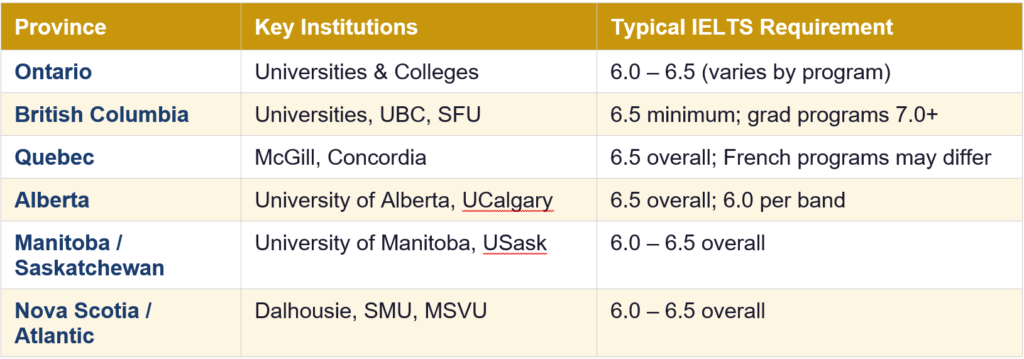
Students targeting institutions in British Columbia and Quebec typically need stronger IELTS profiles. If your score falls short of your target province, consider exploring pathway programs or institutions with conditional admission options – our team of overseas education consultants can map your options accordingly.
IELTS Score Validity and Canadian Immigration
IELTS scores are valid for two years from the test date. For Canadian university applications, your score must remain valid throughout the admissions cycle – from application submission to enrollment.
Beyond university admission, IELTS also plays a role in Canadian immigration pathways. The Express Entry system uses a converted CLB (Canadian Language Benchmark) score based on your IELTS result. Strong language scores can significantly improve your Comprehensive Ranking System (CRS) points.
- CLB 9 (roughly IELTS 7.0 per band) adds meaningful CRS points under Express Entry.
- Students who intend to eventually pursue Permanent Residency benefit from targeting the highest achievable IELTS score – not just the minimum admission threshold.
- Some provinces under the Provincial Nominee Program (PNP) set their own language benchmarks
Common Mistakes That Delay Applications – and How to Avoid Them
Across thousands of student consultations at EdWest Global, these are the most frequent IELTS-related errors we help students avoid:
- Targeting the overall band without checking sub-band minimums.
- Registering for IELTS General Training when IELTS Academic is required.
- Submitting expired scores (older than two years).
- Leaving insufficient time between test date and application deadline.
- Not sending scores directly to universities through the British Council or IDP portal.
- Underestimating preparation time – most students need 3 to 6 months of structured study to achieve target scores.
Alternatives to IELTS: When Other Tests Are Accepted
While IELTS remains the most widely accepted language proficiency test in Canada, some institutions also recognize:
- TOEFL iBT – commonly accepted, particularly at research universities. A score of 90–100 typically equates to an IELTS 6.5–7.0 profile.
- PTE Academic – accepted at a growing number of Canadian institutions and often preferred for faster score turnaround.
- Duolingo English Test – accepted by a limited but expanding set of colleges and some universities, especially post-pandemic.
- Canadian Academic English Language Assessment (CAEL) – specifically designed for Canadian academic settings and accepted at several universities.
As best study abroad consultants working with students from across South India, our guidance is straightforward: unless a university explicitly accepts alternatives, default to IELTS Academic. It remains the most universally recognized credential in Canadian admissions.
A Strategic Approach to IELTS Preparation
Preparation without structure rarely yields improvement. Based on experience supporting students from Telangana, Andhra Pradesh, Tamil Nadu, and Karnataka, here is what a structured preparation approach looks like:
- Diagnostic Assessment (Week 1–2): Take a full-length practice test under timed conditions. Identify your weakest sub-component.
- Targeted Skill Work (Weeks 3–8): Allocate dedicated sessions per skill – do not spread preparation evenly if one area is significantly weaker.
- Academic Writing Focus: Practice Task 2 essays daily. Seek structured feedback on argument clarity, cohesion, and lexical range.
- Mock Tests (Weeks 9–12): Simulate full test conditions. Track improvement per band – not just overall score.
- Score Verification: Once achieved, send scores directly through the official British Council or IDP system – photocopies are not accepted.
How EdWest Global Supports Your IELTS and Canada Journey
EdWest Global operates as a full-spectrum abroad education consultant – not just an admissions processing service. Our role begins well before the IELTS examination and continues through to university enrollment and pre-departure orientation.
As the best study abroad consultant in South India for students targeting Canadian institutions, our advisory process includes:
- Target university shortlisting with sub-band gap analysis based on your current IELTS profile.
- Application timeline planning that accounts for test dates, score release, and institutional deadlines.
- Program-level IELTS verification – because requirements vary across departments within the same university.
- Guidance on conditional admission pathways for students who may be slightly below the required threshold.
- Post-IELTS immigration preparation – ensuring your score also supports your long-term residency strategy.
Our team, based in Hyderabad and serving students across Telangana and the wider South India region, brings direct experience in Canadian university processes. We are among the most established Study Abroad Consultant Telangana practices focused specifically on Canada, the UK, Australia, and Europe.
How EdWest Global Supports Your IELTS and Canada Journey
EdWest Global operates as a full-spectrum abroad education consultant – not just an admissions processing service. Our role begins well before the IELTS examination and continues through to university enrollment and pre-departure orientation.
As the best study abroad consultant in South India for students targeting Canadian institutions, our advisory process includes:
- Target university shortlisting with sub-band gap analysis based on your current IELTS profile.
- Application timeline planning that accounts for test dates, score release, and institutional deadlines.
- Program-level IELTS verification – because requirements vary across departments within the same university.
- Guidance on conditional admission pathways for students who may be slightly below the required threshold.
- Post-IELTS immigration preparation – ensuring your score also supports your long-term residency strategy.
Our team, based in Hyderabad and serving students across Telangana and the wider South India region, brings direct experience in Canadian university processes. We are among the most established Study Abroad Consultant Telangana practices focused specifically on Canada, the UK, Australia, and Europe.
| Ready to Begin Your Study Abroad Journey? At edwestglobal.com, our counsellors guide you through every step – from IELTS preparation strategy to your university acceptance letter. We are among the most trusted overseas education consultants in Hyderabad, with a dedicated team for students across Telangana and South India. Schedule a Free Consultation Today Visit us at www.edwestglobal.com |